
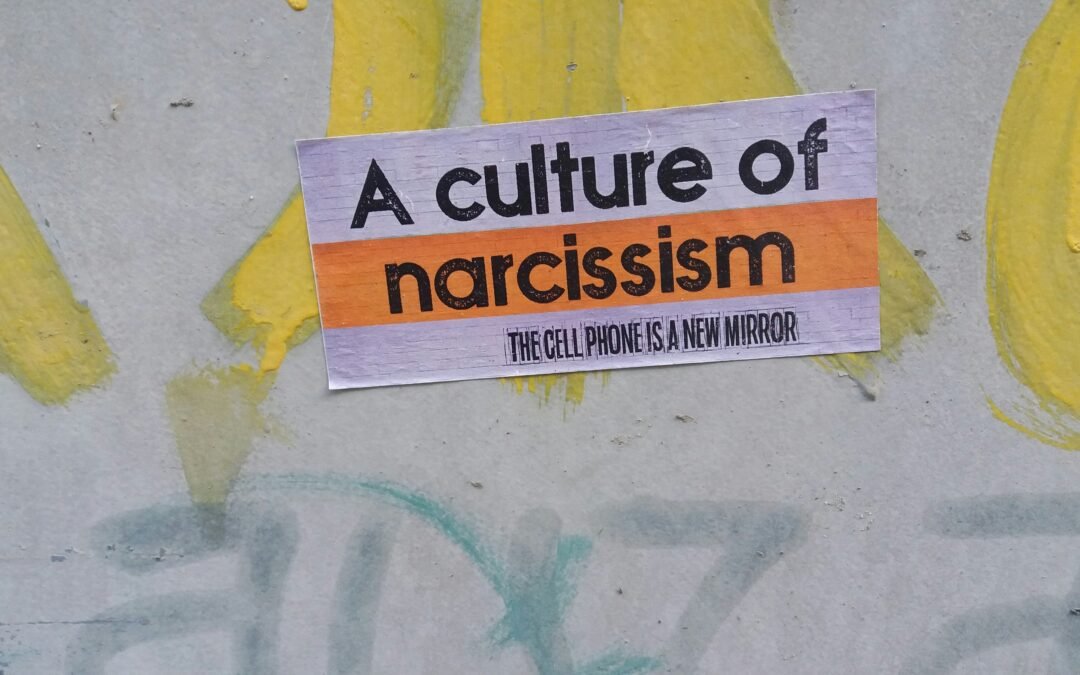
A narcissist in relationships doesn't announce themselves. They don't arrive with a warning label or a history that's easy to read. They arrive with charm. With intensity. With a quality of attention that feels, in the early weeks, like finally being truly seen by another person.
And by the time the other side of them reveals itself — the control, the criticism, the slow erosion of your sense of reality — you are already in deep. Already attached. Already wondering, in that particular way that only people who have been here know, whether the problem might actually be you.
It isn't you. But understanding why it feels that way is the beginning of everything.
What a Narcissist in Relationships Actually Looks Like

The word narcissist gets used loosely in popular culture — often as shorthand for anyone who is selfish or vain or difficult. But narcissistic personality disorder, and the broader spectrum of narcissistic traits that show up in relationships without meeting the clinical threshold, is something more specific and more psychologically complex than simple selfishness.
At its core, narcissism in relationships is characterised by a profound and fragile need for validation. Not the ordinary human need to feel appreciated — something far more consuming than that. A need that shapes every interaction, that drives behaviour in ways the narcissistic individual themselves often cannot see or acknowledge, and that makes genuine reciprocal intimacy almost impossible to sustain.
In practice, what this looks like in a relationship varies depending on whether you're dealing with what researchers call overt or covert narcissism.
The overt narcissist in relationships is the more recognisable type. Grandiose. Confident to the point of arrogance. Quick to take credit and slow to accept blame. Someone who dominates conversations, who responds to criticism with disproportionate anger or contempt, who seems to genuinely believe that the rules that apply to other people don't apply to them.
The covert narcissist in relationships is subtler and, for many people, significantly more confusing to navigate. They present as sensitive, even self-deprecating. They may appear shy or introverted. But underneath the surface is the same core dynamic — the same need for constant validation, the same inability to genuinely empathise, the same tendency to make every conversation, every situation, every relationship ultimately about them. Just packaged differently.
Both types use the same fundamental tools. And understanding those tools is how you start to see clearly.
The Three Stages of a Narcissistic Relationship
One of the most disorienting things about being in a relationship with a narcissist is that it rarely feels like what people describe when they talk about abusive relationships. It doesn't start badly. It starts extraordinarily well. Understanding the three stages that almost all narcissistic relationships move through is one of the most useful frameworks for making sense of an experience that can otherwise feel completely bewildering.
Stage One — Idealisation
The narcissist in relationships begins with what psychologists call the idealisation phase. This is the period — usually the first weeks or months — when you are the most important person in their world. When they are attentive beyond what seems reasonable. When they text constantly, make grand romantic gestures, tell you early and intensely that you are different from everyone else they have ever met.
This is love bombing. And it is not accidental. Whether or not it is fully conscious, it serves a precise psychological function — it creates attachment, it establishes the narcissist as the source of your emotional highs, and it sets a standard of intensity that will be used as leverage later.
The idealisation phase feels extraordinary because it is designed to. The question that eventually has to be asked is not whether it felt real. It did feel real. The question is whether it was sustainable. Whether it was based on genuinely knowing you. And whether it would have continued if you had stopped providing what was needed.
Stage Two — Devaluation
The shift from idealisation to devaluation is rarely sudden. It happens gradually, in ways that are easy to explain away in the moment. A comment that stings more than it should. A withdrawal of warmth that seems to come from nowhere. A growing sense that you are being held to a standard that keeps changing — that what pleased them last week is somehow inadequate this week.
The narcissist in relationships during the devaluation phase begins to erode your confidence through a combination of criticism, comparison, withdrawal, and gaslighting. Gaslighting — the practice of causing someone to question their own perceptions and memory — is particularly central to this stage. When you raise something that hurt you, it becomes evidence of your sensitivity. When you remember something differently from how they remember it, your memory is wrong. When you express a need, it becomes a burden or an attack.
Over time, the effect is cumulative. You become less certain of your own perceptions. More focused on managing their moods. More willing to accept explanations that, if you heard someone else describe them, you would immediately recognise as unreasonable.
Stage Three — Discard
The discard phase occurs when the narcissist in relationships determines that the current supply of validation and attention has been sufficiently depleted, or when a better source of supply has been identified. It can happen suddenly or gradually. It can involve the narcissist ending the relationship or simply withdrawing to such a degree that you end it yourself — often feeling, in a final, cruel twist, as though you are the one who gave up.
The discard is frequently followed by hoovering — attempts to re-establish contact and re-engage your emotional investment, often when the narcissist's new source of supply proves disappointing. Understanding hoovering for what it is — not a genuine change of heart but a tactical re-engagement — is one of the most important pieces of knowledge for anyone trying to break free from a narcissistic relationship cycle.

The Signs of a Narcissist in Relationships
While every narcissistic relationship has its own texture, certain signs appear with enough consistency to be worth naming directly.
They lack genuine empathy. Not the performance of empathy — narcissists can be extraordinarily skilled at appearing empathic when it serves them. But the genuine, spontaneous ability to feel with another person, to be moved by their pain, to prioritise their needs without calculation — this is consistently absent. In a relationship, it shows up as a pattern of conversations that always return to them, of your distress being minimised or redirected, of support that comes with strings attached.
They cannot tolerate criticism. A narcissist in relationships responds to any perceived criticism — however gently delivered, however reasonable — with a disproportionate reaction. Rage, withdrawal, contempt or a swift counterattack that somehow makes you the problem. Over time, this teaches their partners to self-censor, to manage their feelings privately, to stop bringing up things that matter because the cost of doing so is too high.
They keep score. Everything is transactional. Kindnesses are investments that will be recalled at strategic moments. Perceived slights are catalogued and referenced later. The relationship operates as a ledger rather than a partnership.
They are allergic to accountability. A narcissist in relationships almost never genuinely apologises. They may produce the words of an apology — particularly if they need something from you — but the apology is almost always conditional, partial, or followed quickly by a reversal in which your reaction to their behaviour becomes the real problem.
Your reality is constantly questioned. This is gaslighting in practice. You find yourself regularly doubting your own memory, your own perceptions, your own emotional responses. You have been told so many times that you are too sensitive, too needy, too dramatic, that you have begun to believe it.
The relationship is energetically one-sided. You are always the one accommodating, adjusting, managing, and giving. The energy flows overwhelmingly in one direction. You are exhausted in a way that you cannot quite explain to people who haven't experienced it — because from the outside, nothing looks obviously wrong.
Why Leaving Is So Hard
One of the most common questions people ask about narcissistic relationships is why they are so difficult to leave. From the outside, the answer can seem obvious. From the inside, it is anything but.
The difficulty of leaving a narcissist in relationships is rooted in several overlapping psychological dynamics.
The intermittent reinforcement of the idealisation and devaluation cycle creates one of the most powerful attachment bonds known to psychology. When positive reinforcement is unpredictable — when warmth and coldness alternate without a clear pattern — the neurological effect is almost identical to addiction. The highs become more precious because they are unpredictable. The lows become more tolerable because you know the highs can return.
The erosion of self-trust that happens through sustained gaslighting means that by the time many people are ready to leave, they are no longer certain enough of their own perceptions to act on them decisively. They second-guess themselves. They wonder if they are being unfair. They remember the good times with a vividness that the difficult times have somehow been stripped of.
And there is grief. Real, legitimate grief for the person they fell in love with in the idealisation phase — who may have been, at least in part, a performance, but whose absence is felt as a genuine loss.
All of this is normal. All of it makes sense. And none of it means you cannot leave.

What Healing Actually Looks Like
Recovery from a narcissistic relationship is not linear. It does not follow a tidy sequence of stages that culminate in closure. It is messy and non-linear and involves, for most people, a period of profound confusion before clarity begins to emerge.
But certain things consistently help.
Understanding what happened — really understanding it, at the level of psychology rather than just narrative — is one of the most powerful first steps. Not to assign blame endlessly, but to replace the confusion and self-doubt with a framework that makes sense of an experience that was deliberately designed not to make sense.
Rebuilding trust in your own perceptions is slower work but equally important. Learning to treat your instincts as information again. Learning to notice when something feels wrong rather than explaining it away. Learning that your needs are not burdens and your feelings are not evidence of a character flaw.
And when the time comes to consider dating again, take a fundamentally different approach to how you connect with people. Slower. More intentional. More grounded in values and genuine compatibility than in chemistry and intensity.
This is why so many people who have recovered from narcissistic relationships are drawn to conscious dating. Not because they have become cynical about love — quite the opposite. But because they have learned, at considerable cost, that the feeling of intensity is not the same as the feeling of safety. The electric pull of the idealisation phase is not a reliable guide to genuine alignment. That real love — the kind that holds up over time, through difficulty, through the inevitable imperfections of two real human beings trying to build something together — tends to feel quieter and steadier than the narcissistic relationship ever did.
CoreAllure was built with this understanding at its foundation. The five alignment questions in the onboarding are not arbitrary. They are designed to surface the things that actually matter — values, readiness, truth — before appearance or chemistry have a chance to override good judgment. The AI that matches you is not looking for someone who gives you that electric feeling. It is looking for someone genuinely compatible at the level that determines whether love lasts.
For anyone emerging from a narcissistic relationship and wondering whether real love is still possible — it is. But it tends to look different from what you were taught to recognise as love. It tends to feel different. Calmer. More consistent. Less like fireworks and more like coming home.
And that, it turns out, is not a consolation prize.
It is the whole point.
[Join the CoreAllure waitlist — because you deserve alignment, not intensity →]
Related Article: Why You Keep Attracting the Wrong People (It’s Not Bad Luck)